
Middle Years Programme (MYP)
Inspiring Critical Thinkers, Compassionate Leaders, and Lifelong Learners
Academic challenge, grounded in faith and service
The International Baccalaureate (IB) Middle Years Programme (MYP) is an internationally recognized educational framework designed for students aged 11–16 years. At Omar Ibn Al Khattab Academy, the programme spans Grades 6–10, providing a challenging and engaging education that connects academic learning with the world beyond the classroom.
As an IB MYP Candidate School, we are committed to developing a programme that integrates the Alberta curriculum, the IB philosophy, and Islamic values. Students are encouraged to become independent learners who ask thoughtful questions, explore different perspectives, and apply their understanding with confidence, integrity, and purpose.
Learning in the MYP goes beyond acquiring knowledge. Through inquiry, conceptual understanding, reflection, and meaningful action, students develop the skills and character needed to navigate an increasingly interconnected world while remaining grounded in faith and service to others.
Why Choose the Middle Years Programme?
The MYP offers a broad and balanced education that supports students’ intellectual, social, emotional, and physical development. Within our Islamic learning environment, spiritual growth and ethical responsibility enrich this educational experience.
Our programme aims to provide:
- A caring, inclusive, and faith-centred learning environment
- Academic learning aligned with Alberta curriculum outcomes
- Inquiry that connects subject knowledge with real-life situations
- Strong foundations in language, mathematics, science, and the humanities
- Opportunities to develop creativity through arts and design
- Physical education that promotes health, teamwork, and well-being
- English and Arabic language development
- Islamic Studies and Qur'an education
- Explicit teaching of communication, research, thinking, collaboration, and self-management skills
- Opportunities for student leadership, service, and independent inquiry
- Meaningful partnerships between students, teachers, and families
By combining academic challenge with character development, the MYP helps young people become thoughtful, principled, and compassionate members of their communities.
Learning Through Inquiry
Asking Questions, Building Understanding, Making Connections
Inquiry is central to learning in the MYP. Students investigate significant ideas, explore authentic problems, and consider how their learning applies to personal, local, and global situations.
Teachers guide students through purposeful learning experiences that build subject knowledge while encouraging analysis, creativity, discussion, and reflection.
Through this approach, students deepen their understanding and become increasingly confident in directing their own learning.
Students are encouraged to:
- Ask factual, conceptual, and debatable questions
- Investigate issues using reliable evidence
- Compare perspectives and evaluate explanations
- Make connections within and across subjects
- Develop and justify their own conclusions
- Apply knowledge and skills in unfamiliar situations
- Reflect on feedback and improve their work
- Take thoughtful and responsible action
Our Curriculum
A Broad and Balanced Education
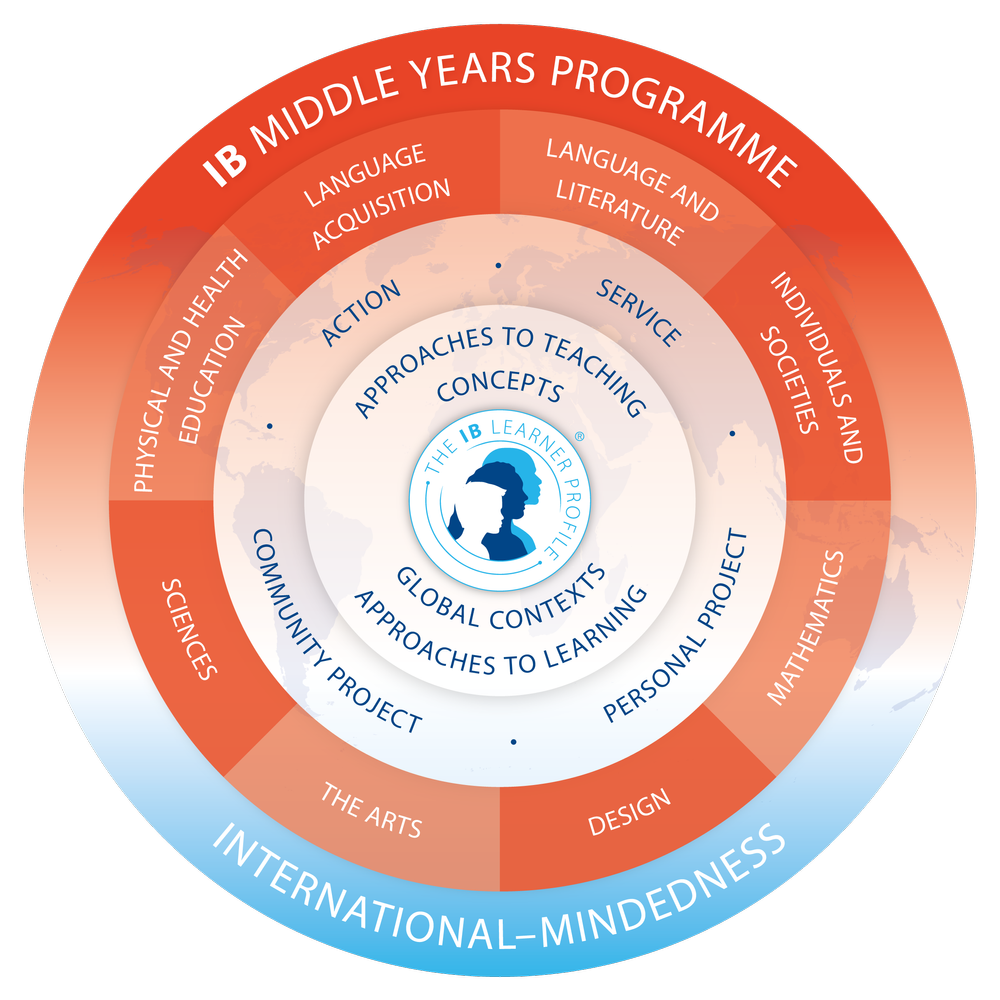
The MYP curriculum is organized into eight subject groups. Together, they help students develop a range of knowledge, skills, and perspectives.
Language and Literature
Developing critical reading, purposeful writing, discussion, and interpretation through literary and non-literary texts.
Language Acquisition
Building communication skills in an additional language while developing appreciation for linguistic and cultural diversity.
Individuals and Societies
Investigating people, communities, histories, environments, and the systems that shape our world.
Sciences
Exploring scientific ideas through investigation, experimentation, evidence, and consideration of their real-world implications.
Mathematics
Developing reasoning, problem-solving, communication, and the ability to apply mathematics in meaningful contexts.
Arts
Encouraging creativity, expression, interpretation, and reflection through artistic learning experiences.
Physical and Health Education
Developing movement skills, healthy habits, collaboration, and understanding of personal well-being.
Design
Applying a structured design process to investigate needs, develop ideas, create solutions, and evaluate their effectiveness.
Alberta curriculum outcomes are addressed through subject learning, while Islamic Studies and Qur’an education enrich students’ understanding of faith, values, and responsibility.
Learning Through Global Contexts
Connecting Classroom Learning with the Wider World
The MYP uses six global contexts to help students understand why their learning matters and how it connects to human experiences.
Identities and Relationships
Exploring identity, relationships, health, well-being, and what it means to be human.
Orientation in Space and Time
Investigating histories, journeys, discoveries, and connections between people across time and place.
Personal and Cultural Expression
Examining how people express ideas, beliefs, values, creativity, and culture.
Scientific and Technical Innovation
Exploring the natural world and how scientific understanding and technology influence people and environments.
Globalization and Sustainability
Investigating interconnected systems and the impact of decisions on communities and the planet.
Fairness and Development
Considering rights, responsibilities, access to opportunities, and the pursuit of a fairer world.
These contexts encourage students to connect academic learning with meaningful questions and develop awareness of their responsibilities within local and global communities.
Approaches to Learning (ATL)
Building Skills for Independent Learning
Success requires students to understand both what they are learning and how to learn effectively. The MYP develops Approaches to Learning (ATL) skills that support students across subjects and beyond school.
Students develop skills in five areas:
Communication
Listening carefully, expressing ideas clearly, interpreting information, and communicating for different purposes.
Social Skills
Collaborating respectfully, sharing responsibility, resolving disagreements, and considering others’ perspectives.
Self-Management
Organizing time and materials, managing emotions, persevering through challenges, and reflecting on progress.
Research
Finding, evaluating, organizing, and using information responsibly.
Thinking
Analysing evidence, generating ideas, solving problems, and transferring understanding to new situations.
Teachers explicitly model these skills and provide opportunities for students to practise, receive feedback, and build independence.

Interdisciplinary Learning
Bringing Subjects Together
Real-world questions often require understanding from more than one subject. Interdisciplinary learning helps students bring together knowledge and methods from different disciplines to develop a deeper understanding.
Students might combine science and design to explore sustainable solutions, mathematics and humanities to interpret community data, or language and the arts to communicate an important message.
Through thoughtfully planned interdisciplinary experiences, students learn to:
- Recognize connections between subjects
- Apply different methods to a shared question
- Combine evidence and ideas to develop understanding
- Explain how different disciplines contribute to a solution
- Reflect on the value and limitations of their approach
These experiences help learners use their knowledge flexibly and purposefully.
Developing the Whole Learner
Strong Minds, Strong Character, and Purposeful Lives
At Omar Ibn Al Khattab Academy, education supports the growth of the whole learner. Academic achievement is strengthened by positive relationships, emotional awareness, physical well-being, spiritual development, and a clear sense of responsibility.
The IB Learner Profile encourages students to become:
Inquirers
who nurture curiosity and develop the skills to investigate
Knowledgeable
learners who explore significant concepts and issues
Thinkers
who use critical and creative thinking to make reasoned decisions
Communicators
who express themselves confidently and collaborate effectively
Principled
individuals who act with honesty, fairness, and integrity
Open-minded
learners who appreciate different perspectives and experiences
Caring
individuals who demonstrate empathy, compassion, and respect
Risk-takers
who approach uncertainty with preparation, courage, and resilience
Balanced
individuals who attend to their intellectual, physical, and emotional well-being
Reflective
learners who consider their strengths, challenges, and next steps
Within our Islamic learning environment, these attributes are reinforced through gratitude, humility, justice, perseverance, compassion, and service. Students are encouraged to put these values into practice in their learning and daily interactions.
Language Learning
Empowering Communication and Understanding
Language enables students to learn, question, connect, and express their identities. Our language programme supports confident communication in English and the development of Arabic, while respecting students’ home languages and cultural backgrounds.
Students strengthen their language skills through:
English Language and Literature
Reading, analysing, discussing, and creating a range of texts.
Arabic Language Learning
Developing reading, writing, speaking, and listening skills through appropriate levels of challenge and support.
Qur'an Studies
Strengthening recitation and reflection through connections with Islamic teachings.
Islamic Studies
Exploring faith, ethical questions, and values through discussion and thoughtful expression.
Academic Language Across Subjects
Learning the vocabulary and forms of communication needed in each discipline.
Presentations and Discussions
Explaining ideas, supporting opinions with evidence, and listening respectfully.
Language Support
Providing scaffolds and targeted support to help learners access the curriculum and communicate their understanding.
By developing language across the curriculum, students become more confident readers, writers, speakers, and thoughtful listeners.
Assessment for Learning
Clear Expectations, Meaningful Feedback, and Continuous Growth
Assessment is an integral part of teaching and learning in the MYP. It helps students understand their progress and enables teachers to plan appropriate support and challenge.
MYP assessment uses subject-specific criteria linked to the programme’s objectives. Students learn what successful work looks like and how to use feedback to improve their understanding and performance.
Our assessment approach includes:
Clear Learning Goals and Success Criteria
Helping students understand the purpose and expectations of a task.
Formative Assessment
Gathering evidence during learning through questioning, observations, discussions, practice, and draft work.
Summative Assessment
Providing opportunities to demonstrate learning through purposeful tasks at appropriate points in a unit.
Authentic Tasks
Applying knowledge and skills through investigations, performances, presentations, designs, and written responses.
Self-Assessment
Encouraging students to evaluate their work against shared criteria and identify next steps.
Peer Feedback
Teaching students to offer specific, respectful, and useful feedback.
Reflection and Goal Setting
Supporting students in recognizing progress and taking responsibility for improvement.
Accessible Assessment
Providing appropriate support so students can demonstrate their learning.
Regular communication through Toddle helps students and families understand learning expectations, upcoming assessments, feedback, and progress.
Service as Action
Turning Learning into Meaningful Contribution
The MYP encourages students to use their learning to contribute to the lives of others. Service as action connects inquiry with responsible participation in the community.
Students are guided to identify needs, listen to others, plan appropriate responses, and reflect on the impact of their actions.
Opportunities may include:
- Supporting environmental responsibility
- Contributing to school and community initiatives
- Raising awareness of issues that affect others
- Sharing knowledge and skills
- Collaborating on projects that respond to an identified need
- Reflecting on ethical choices and personal responsibility
Grounded in Islamic values, service encourages students to act with compassion, humility, and sincerity. The emphasis is on thoughtful participation, learning, and meaningful contribution.
The Personal Project
Exploring Interests and Demonstrating Independence
The personal project is a culminating feature of the final year of the MYP. It gives students an opportunity to pursue an area of personal interest and demonstrate their ability to manage a sustained learning process.
As our programme develops, students will be prepared to:
- 1. Identify a meaningful learning goal
- 2. Plan a product or outcome and establish success criteria
- 3. Conduct research and use information responsibly
- 4. Apply relevant Approaches to Learning skills
- 5. Manage time, resources, and challenges
- 6. Evaluate their outcome against their criteria
- 7. Reflect on how the experience has influenced their learning
With guidance from a supervisor, students take increasing ownership of their work, developing confidence, perseverance, and readiness for further study.
Innovation and Future-Ready Learning
Creating, Investigating, and Solving Problems
The MYP encourages students to use knowledge creatively and respond thoughtfully to a changing world. Design, scientific inquiry, research, and responsible technology use provide opportunities to develop practical solutions and informed perspectives.
Learning experiences can include:
Design Thinking
Investigating needs, developing ideas, testing solutions, and evaluating outcomes.
STEM Inquiry
Applying science, technology, engineering, and mathematics to meaningful challenges.
Digital Creation
Using appropriate tools to communicate, model, design, and present understanding.
Computational Thinking
Breaking down problems, recognizing patterns, and developing logical solutions.
Digital Citizenship
Protecting privacy, evaluating online information, and communicating responsibly.
Academic Integrity
Acknowledging sources and demonstrating honest, original work.
Responsible AI Literacy
Considering the accuracy, limitations, and ethical implications of emerging technologies.
These experiences help students become thoughtful creators and informed users of technology.
Calligraphy and Physical Education
Essential Areas of Our Curriculum
At Omar Ibn Al Khattab Academy, calligraphy and physical education are integral subjects within our curriculum. They develop creativity, understanding, problem-solving, physical competence, and collaboration through structured learning and assessment.

Calligraphy
Students develop artistic expression, precision, concentration, and an appreciation of Arabic calligraphy and Islamic artistic traditions.

Physical and Health Education
A strong programme develops fitness, movement skills, sport-specific techniques, healthy habits, teamwork, leadership, and sportsmanship. We aim to build school teams through structured coaching and training, preparing students for local competitions and working towards national participation.
Together, these subjects support academic and personal development, encouraging students to pursue excellence and demonstrate discipline, integrity, and respect.
A Strong Partnership with Families
Working Together to Support Student Success
Families are valued partners in students’ academic, personal, and spiritual development. Strong communication between home and school helps young people build confidence, independence, and positive learning habits.
Family engagement is supported through:
- Parent–teacher conferences to discuss progress and next steps
- Student reflections and learning portfolios
- Learning showcases and presentations
- Information sessions about the MYP and assessment
- Regular learning updates and assessment communication through Toddle
- Conversations about organization, well-being, and responsible technology use
- Community events and opportunities to support school initiatives
Together, teachers and families help students take increasing responsibility for their learning while ensuring they feel supported, understood, and appropriately challenged.
Preparing Students for a Lifetime of Learning
Building Confidence for the Next Stage
The MYP builds on the inquiry developed in the primary years and prepares students for further secondary education, including Alberta high school courses and future IB Diploma Programme pathways.
Through academic challenge, independent learning, collaboration, and reflection, students develop the habits needed to approach new opportunities with confidence.
Grounded in Islamic values and guided by the IB philosophy, our goal is to nurture young people who are:
Intellectually curious and willing to investigate
Principled in their choices and actions
Respectful of diverse perspectives
Confident communicators and thoughtful collaborators
Resilient and increasingly independent
Caring and committed to serving others
Prepared to apply their learning with purpose
Omar Ibn Al Khattab Academy is a Candidate School* for the Middle Years Programme (MYP). This school is pursuing authorization as an IB World School. These are schools that share a common philosophy – a commitment to high quality, challenging, international education that Omar Ibn Al Khattab Academy believes is important for our students.
*Only schools authorized by the IB Organization can offer any of its four academic programmes: the Primary Years Programme (PYP), the Middle Years Programme (MYP), the Diploma Programme, or the Career-related Programme (CP). Candidate status gives no guarantee that authorization will be granted. For further information about the IB and its programmes, visit www.ibo.org
Begin the Journey
Ask meaningful questions.
Connect learning with the world.
Act with integrity and compassion.
Grow into an independent, lifelong learner.